Showing posts with label Week 3. Show all posts

Sunday, February 4, 2018

Famous Last Words: busiest week of the semester so far

This week has been quite a doozie! I think this was actually my most busy week yet! I did not get in my 20+ hours of MCAT prep for the week, but I am not beating myself up over it or anything. One thing I am proud about is that I kept myself on a really good sleeping schedule this week and did everything I could to get to bed on time. I was also able to volunteer on Saturday as well at a clinic called Manos Juntas!
Anyways, even though last week did not go quite as planned, I am expecting this week to go smoothly because I am choosing to fail-forward! This week I have my first test in genetics and my first test in Latin. I am feeling kind of anxious, but I feel confident that if I keep my studying consistent, by the time the test comes i will have no problems.

Other reflections on the week are... the readings! I love The Ramayana by R.K. Narayan! I actually finished the rest of the book earlier today! I am very excited to start on my writing assignments soon for next week and have got great plans for my story! This week I combined Don Giovani by Mozart, an opera, into my retelling of the story of the Ramayana. After I did some blog commenting today, I realized that other people have really great stories as well so this week I plan to make the story a lot more original and inventive!!

Lastly, my final reflection is on today. Earlier this afternoon I went home to do some laundry and for the first time I was really happy to see my mom and dad. They were working on a project and I just had an extreme moment of thankfulness for everything that they've done for me.

Related image
Don Giovani image from lincolncenter

Feedback Strategies: Pro-praise - Pat's thoughts

I chose to read an article about the language that helps kids grow, preshoolers and praise, and then another article about the negative consequences of too much praise, criticizing praise.

I found both articles really interesting and the article by Alfie Kohn , criticizing praise, brought up an important issue that I never considered before when I praised others. Kohn's idea basically states that feedback, if given too much in our culture, can become superficial and is meant to bring elicit a certain response rather than train the mind. The author further extends that our culture indulges too much in praising for things that people should already do. Although I am a proponent of praising, I do see Kohn's point in superficiality. I realized that during the summer time Albert is in charge of giving feedback to other students based upon their nightly reports of how they did during the day. Based upon what I have witnessed, I think that praising people opens up their minds to feedback and is therefore effective when getting the message across.

The next article,  preshoolers and praise, is really fascinating to me. I really like the idea of replacing 'generic praises' with more tailored phrases according to the individual. These concepts will serve me well during the summer time as I think about positive things to tell Albert on his attitude. I think that both articles are useful, and that to praise genuinely and tailored to the individual is the most effective form of feedback.


Related image
image taken from giphy
~pat

Saturday, February 3, 2018

Topic Research: A portfolio of Western Literature meets Eastern Indian Mythology with Patrick ALSO IN IT

So after reading through the project choices of Storybook or Portfolio, I am still not sure where I am leaning to go! However, for the past three weeks of school, I have really enjoyed reading books in my Fate and the Individual Part II class which is based off of a syllabus by W.H. Auden when he taught a course that involved over 6,000 pages of reading in a semester. I love both parts of the class at OU. Anyways, currently my ideas are leaning toward continuing to reflect on the Indian stories and doing a Portfolio...unless I find something else that I think is funnier.

Here's what I got so far:

The Ramayana by R.K. Narayan
The Mahabharata by R.K. Narayan
And a collage tales either from the Jatakas and other tales read online in the extra credits: thejatakas

The overarching theme will be W.H. Auden's ghost guiding Patrick through his thoughts about the  Indian Epics and Tales by retelling the story where Patrick is inside the stories along with different heroes and villains accumulated in the books that Auden suggested in his original syllabus. The heroes and villains will probably include Faust from Goethe's Faust, Elizabeth Bennett from Jane Austen's Pride and Prejudice, and whatever else I decide on as the semester continues. The final project will also include quotes from poetry by W.H. Auden which I will attempt into being the overarching message of the story (more on this later) - kind of like how in the Star Wars: The Clone Wars animated TV show had a message at the beginning of each episode to guide the plot.
tumblr-mb8gp7ozh21qz4v5ho1-1280-png
                         here is the syllabus by Auden. picture taken from theparisreview

Friday, February 2, 2018

Week 3 story - Don Giovani in the Ramayana with Patrick as the sage

One day a sage named Patrick Startrick arrived into the Kosala country from far away. He traveled for 10 whole weeks without taking any breaks. The legendary sage was originally a sea star, but through sheer will power and determination, turned himself into wood. Dasaratha, the emperor of the Kosala country, who governs and protects his people heard the prophecies of the legendary star who will one day come and train his son Rama to bring justice to the land.

Upon landing, Dasaratha greated the wise Patrick and offered his kingdom as refuge from his travels. The wise Patrick replied he did not need any rest as his sage status does not require him to perform any external bodily functions - thus he does not need to eat, sleep, or defecate (also, being made out of wood helps out with this too). After refusing the hospitality of the king, Patrick mentions the real reason why he is there - to bring and train the young Rama to become the strongest person in the universe.

Dasaratha, surprised, quickly tries to turn Patrick's mind away from that possibility of bringing the young Rama out into battle, and instead offers his own personal body and army. Patrick refuses and instead starts to leave immediately. After a few thoughts and considerations, the emperor finally orders his advisers to bring the young Rama forward and prepare him for his training. 

Patrick then trains Rama until Rama's adulthood and then brings Rama back to the Kingdom. By this time Rama had become a strong and handsome man, in fact the most handsome out of all the lands. Both men and women all were swooning over the thoughts of Rama. Particularly one individual in particular, a gay (gay as in homosexual) demon disguised as an aristocrat who lived in the forest named Don Giovani.
Don Giovani is perhaps one of the most powerful of all gay demons in all the land, who had a specific character of being the opposite of a womanizer, he was a man-izer. Don Giovani would seduce young men in all the Indian kingdoms to be his husband. The story goes that once Don Giovani heard about the handsome Rama, he scheme his brother in law, Leporello, into trying to bring Rama into woods. Leporello, famous for being the master of none, then devises an intense plan to bring Rama into the woods, by disguising as one of Dasaratha's wives, Kaikeyi, so that she could force Dasaratha's hands into exiling Rama. Long story short, Leporello, who is now disguised as one of Dasaratha's wives casts some magic onto Dasaratha so that he would announce his retirement from being emperor. Leporello then trick Dasaratha into believing that he owes him a favor and that Rama must be exiled if Dasaratha were to be a man of integrity. Shocked and frozen, Dasaratha goes into an intense mode of weeping and silence, forcing everyone to worry about the state of the emperor. 
Leporello then seizes this opportunity to bring the young Rama into the woods!

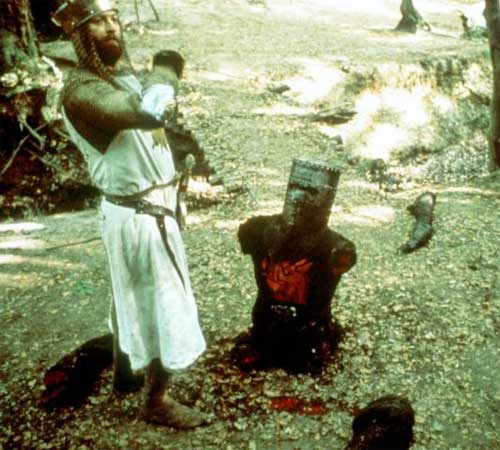
Skipping a few key events, Rama ends up fighting Don Giovani in a semi-epic battle of good and evil with the climax being Patrick cutting off Don Giovani's nose, ears. arms, and legs. Don Giovani then now only a body figure with no arms and legs still challenges the heroes to further fights, but the young Rama and Patrick go somewhere else.
Image result for Monty Python knight with no arms
image take from thingsthatmadeanimpression

Author's Notes:
The original story had the sage named Viswamithra who was legendary and could control all of his bodily actions through sheer will power. I replaced Viswamithra with Patrick because Patrick is made out of wood and therefore does not need any bodily actions. Furthermore, the blog is meant to reflect creatively Patrick and his thoughts into the Indian Adventures.
I got the idea of Don Giovani being a bad guy in my spin-off of the story because this week we read the opera, Don Giovani by Motzart, in my Fate and the Individual Pt. II, and my professor Dr. McClay really got me excited about the Don as a character and villain. He was famous for being a womanizer so in my spin off I made in really really gay so that he would have to face Rama. I did this by replacing Soorpanak, the demon in the forest, with Don Giovani. I also put patrick in the fights as well. I also thought it would be funny to make a Pony Python reference by having patrick cut off all her arms and legs.

Bibliography:
Narayan, R. K., and Kampar. The Ramayana: a Shortened Modern Prose Version of the Indian Epic (Suggested by the Tamil Version of Kamban). Penguin Books, 2006. 

Thursday, February 1, 2018

Reading Notes: Part B Ramayana - Patrick's Discoveries

So far the Epic follows Rama's adventures in the woods. Rama just ran into Soorpanaka who, madly is love with him, tries every method of deceit in order to win Rama's love. Rama, however, did not yield to the demonic creature. The depiction of Rama here is fascinating as he is the embodiment of human completeness - winning the love of unearthly beauty and feigning off the deceit of demonic powers. The story continues with Soorpanaka being devestatingly mutililated by Lakshmana who detected Soorpanaka's egregious plan a mile away.  Soorpanaka eventually tries to grab Rama by force and her army is defeated, in which case she turns to the aid of her her brother, Ravana. Ravana intercedes under the pretense of attaining Sita as his divine love, being that she should desires him first before desiring any mortal, makes it his plan to capture Sita and avoid direct conflict with Rama at all cost. Ravana succeeds in his endeavor to capture Sita.

Perhaps the most interesting theme of the depiction of the gods in The Ramayana is the fact that all these gods are struck by earthly appetites. Such feelings of pleasure, anger, jealously, and revenge affect humans as much as they affect the gods. The theme of appetite in supposedly immortal figures seem to exist not only in western pagan views of gods but also eastern ones. It brings up speculation that perhaps the eastern powers were exposed to the west's oral stories of their gods.

Another interesting concept is the language that the author uses to describe confrontation with the gods - particularly when Jatuya obstructs Ravana's getaway by presenting what he calls a 'challenge.' The use of the word "challenge" is powerful because it connotes a theme of justification for action - just as it is worthy to challenge somebody to a dual and to win something as a prize, the idea of challenge seems to be an important concept of for justifying actions. 

Ideas for my story would perhaps involve some type of story where Patrick is taken away as a prize or Ravana goes mad because of patrick's form and figure.

Mareechi being shot by Rama - image taken from asuras anonymous

Bibliography:
Narayan, R. K., and Kampar. The Ramayana: a Shortened Modern Prose Version of the Indian Epic (Suggested by the Tamil Version of Kamban). Penguin Books, 2006.

Tuesday, January 30, 2018

Reading Notes: Part A of the Ramayana - Patrick's discoveries

The Ramayana by R.K. Narayan is the coolest epic that absorbed me into its world in such a short matter of time. The first part of the story carries the theme of longing that seems to be the basis of the relationship between the Father, Dasaratha, and his son, Rama. In the beginning of the text, the sage, Viswamithra arrives to the Dasaratha's kingdom and requests the help of Rama in order to vanquish some demons and bring justice to the land. The king originally said no to the request and after trying to configure a different option, concedes to allowing Rama go with the sage. The king's response to the request is sincere and reminds me of the longing that most parents have for the future of their children - in that their children are safe and successful. The deeper matter seems to be that the king's response is a defensive response to the fear of the unknown. This theme of impending unknown shows up often in the text in other parts of the story as well including when Gautama turned his wife to stone as his wife did not know exactly when she would be brought back to normal. Perhaps the mos revealing of the fear of unknown is revealed when Dasaratha deprecates upon hearing that his son Rama voluntarily went into the exile which is the forest. The Father eventually dies from his grief after hearing that his son will not come back to rule.

Other fun notes were the similarities between Homer's Odyssey in the stringing of Shiva's bow, as Rama was the only and legitimate person capable of stringing the royal bow just as Odysseus was able to string his own bow and ward of the suitors. I am not sure if Narayan wrote that part of the story on purpose or if the story of the Ramayana were told through the lens of understanding Greek epics but I find it fascinating how similar those two parts of the story are. 

More fun lines - I like how on the first page, Viswamithra denied needing any rest because he basically mastered all of his inner bodily needs through self-discipline. That classification of oneself is so fascinating to me as I typically don't have any inner bodily needs since I am made out of wood, so maybe I could start thinking of myself as a type of sage. Perhaps I too can reach that level of discipline through sheer will power and austerity just as the sage did.

image taken from neveryetmelted

Bibliography:
Narayan, R. K., and Kampar. The Ramayana: a Shortened Modern Prose Version of the Indian Epic (Suggested by the Tamil Version of Kamban). Penguin Books, 2006.

Week 13 Reading Part B

I read Dharma's version of The Mahabharata  where  Dṛṣṭadyumna chastises the Pandava brothers. Arjuna is really sad that so many people ...