Showing posts with label Week 7. Show all posts

Friday, March 2, 2018

Week 7: Story Planning Faust and death

Last week I wrote a story on Moby Dick and took a scene from the Ramayana where Rama talked with Bharata. I am continuing my fusion of western and eastern literature this week and am going to focus on Goethe's Faust and The Mahabharata. I plan to take the plot of the Mahbharata where Yudihistera answered the the god of death.
In Faust, the main character, Faust, is disatissfied with life and wants thinks about ending his life. The plot will be Faust's contemplation of killing himself. Faust creates a vial of poison that he wants to drink from and end his life. However, his friend Wagner approaches Faust at the last minute, and in an attempt to derail Faust's suicide, ends up asking lots of philosophical questions about the meaning of life and why it is worth living. Faust ends up answering all of Wagner's questions and in the end, Wagner leaves the decision to Faust on whether he wants to end his life or not. Realizing now the error in his judgement, but also realizing the void that is his own existence, Faust chooses to pursue another course of destruction and summons Mephistopheles, the devil incarnate.
Having summoned Mephistopheles, Faust asks if life is still worth living. The devil answers that faust has already experienced all the maximum pleasures of his current existence and that if there is nothing else to do, life itself is meaningless. Having realized the further nihilism of this, Faust chooses to drink the poison and thus end his life. Mephistopheles is quite happy and brings Faust's soul to hell.

Author's Notes:

The story telling will be a twist from what happens in the Mahabharata and instead of ending in a happy story where all the Pandavas live again, Faust instead will die and go to hell thus sealing his fate with the devil. I want to highlight that there is no hope for Faust as he has already made up his mind that life is not worth living. I'm not sure where else I want to go but I want to continue making the theme of my stories darker and more serious. This story will be more dark and realistic as I want to depict the human suffering that people must face in their decisions, just as Yudihistera must bear the weight of his leadership and all its repercussions.
Image result for yudhisthira and yaksha
Yudihistera and Yaksha disguised as a crane source

Bibliography:

The Mahabharata by R.K. Narayana
Faust by Goethe

Wednesday, February 28, 2018

Reading Notes: The Mahabharata Part A

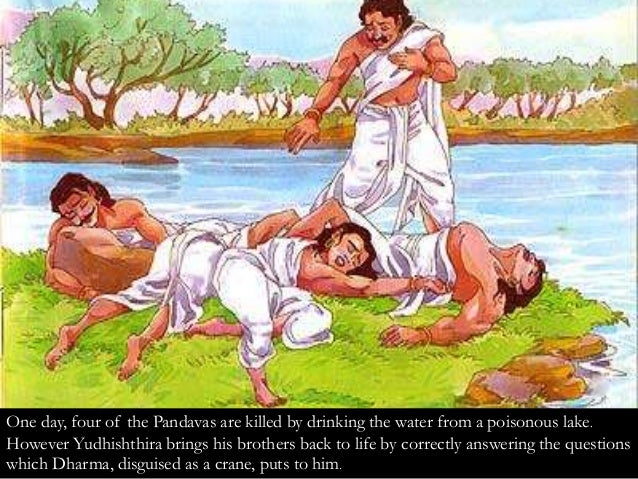
For this part of the notes, four of the five brothers in the Pandavas died from drinking in a water before answering the questions of Yama. The chapter represents Hell and is particularly interesting because the Death God, Yama, disguised himself in order to trick the family. There is a theme of hubris in the Pandavas as they seem like they are all too powerful to even heed the divine signs of nature. Only Yudhistera was able to overcome his own thirst and sorrow for the death of his brother to answer the questions of Yama. 
Once again, Narayan's writing style of this chapter is very brief and really more factual than emotional. He skips over all the philosophical hindu meanings of the conversation and just mentions in the footnotes that they are those types of conversations. I assume because he is appealing to a different and wider generation of people that most people would not understand the old hindu religion and so he chooses to skip over them. I think that by skipping over such key details and speaks of the philosophy detracts from how we can understand the text as a whole however and I would have really appreciated learning about what the encounter with Yama means philosophically as it seemed like a very deep part of the text.

Related image
Yudhistera standing over the dead bodies source

Week 13 Reading Part B

I read Dharma's version of The Mahabharata  where  Dṛṣṭadyumna chastises the Pandava brothers. Arjuna is really sad that so many people ...